Omelia per l'affinamento della Santa Croce
Homily for the Finding of the Holy Cross
Fourth Sunday after Easter
Qui salutem humani generis in ligno Crucis constituisti:
ut unde morte oriebatur, inde vita resurgeret,
et qui in ligno vincebat, in ligno quoque vinceretur.
Preface of the Holy Cross
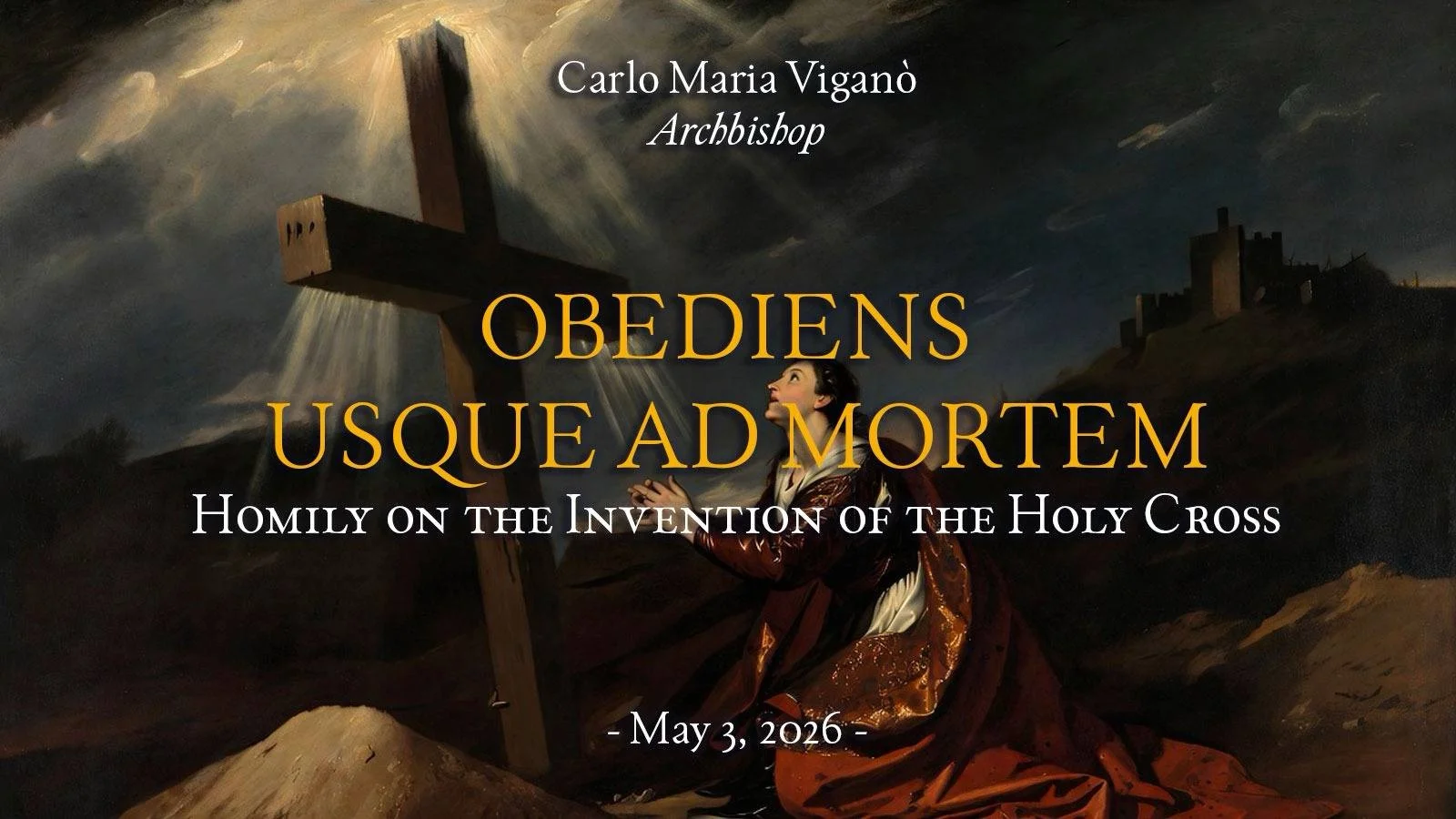
Today we celebrate the Feast of the Invention of the Holy Cross, a day particularly dear to Familia Christi, for it marks the anniversary of the priestly ordination of the Servant of God Msgr. Giuseppe Canovai in 1931, as well as that of our dear Don Riccardo Petroni. The Invention—that is, the rediscovery—of the Holy Cross commemorates a historical event that took place in the year 326, when Empress Helena, mother of Constantine the Great, succeeded in discovering the site near Calvary where the True Cross lay buried. According to established Patristic and liturgical accounts (found in the writings of authors such as Saint Ambrose and Rufinus, as well as in Jacobus de Varagine’s Golden Legend), following the Lord’s Passion, the Cross was cast into a pit or buried in the soil of Calvary to prevent it from becoming an object of veneration among the early Christians.
The exact burial site of the Cross on Golgotha—known only to a small circle of Jewish families driven by religious hostility—was passed down from generation to generation as a jealously guarded secret, out of fear that its discovery might confirm the truth of the Christian Faith. Saint Helena summoned the leading figures of the Jewish community and explicitly requested information regarding this location. All denied any knowledge or feigned ignorance, save for a rabbi named Judas (identified as a descendant or grandson of Zacchaeus, the tax collector from the Gospels), who knew the secret because his family had handed it down through the generations. His ancestors had either witnessed or learned of the decision to bury the crosses following the Passion in order to prevent their veneration. Judas, however, refused to reveal what he knew. Consequently, the Empress had him lowered into an empty cistern situated near Golgotha, depriving him of food and water. After a week, the rabbi prayed to the Lord; enlightened by divine grace, he inwardly recognized the truth of Christ. He then promised to indicate the exact site of the Crucifixion and was set free. Baptized with the name Cyriacus by Macarius, the Bishop of Jerusalem, he was elected Bishop upon the latter’s death and received the title Inventor Crucis (Discoverer of the Cross). He was martyred on May 1, 363, under the Emperor Julian the Apostate, and his remains rest in the Cathedral of Ancona, the city of which Cyriacus is the Patron Saint.1
Saint Helena ordered the demolition of the pagan temple dedicated to Venus (or to Jupiter) that Emperor Hadrian had erected on Golgotha to desecrate the site held sacred by Christians and to obliterate its memory. Excavations were carried out at the spot indicated by Cyriacus, bringing to light a cistern into which the crosses—that of Jesus and those of the two thieves—had been cast, together with the Nails of the Crucifixion, the Crown of Thorns, and the Titulus Crucis (the beam with the inscription Iesus Nazarenus Rex Iudæorum). To identify the True Cross, Helena had a gravely ill person brought before her; upon mere contact with the Cross of Our Lord, the individual was instantly healed, thereby attesting to the authenticity of the precious Relic.2
Three centuries later, in 614, during the war against the Sassanid Persians, the Basilica of the Holy Sepulcher—which Constantine and Saint Helena had built—was set ablaze and devastated. The relics of the True Cross were carried off as spoils of war to the capital, Ctesiphon, and desecrated; they were incorporated into the right side of Khosrow’s throne, while a column surmounted by a rooster (serving, in this parody, as a symbol of the Holy Spirit) was placed on the left. Khosrow himself sat in the center, demanding to be worshipped as “God the Father,” with the Cross representing the Son on his right and the rooster symbolizing the Holy Spirit. This impious blasphemy against the Most Holy Trinity did not go unpunished: in 628, Emperor Heraclius, following a heroic campaign, defeated the Persians at the Battle of Nineveh. Khosrow II was deposed by his son Siroes and beheaded. Among the terms of the peace treaty, the Byzantines secured the return of the True Cross. Heraclius personally brought it back to Jerusalem on September 14, 629, entering the Basilica barefoot and clad in penitential garb to solemnly venerate the Precious Wood in its place of origin. This historical event is commemorated in the Feast of the Exaltation of the Holy Cross each year on September 14.3
But why—we might ask—such fierce hostility toward the Cross upon which the Redeemer was nailed and died? Because three days later, He truly rose from the dead. Our Lord conquered death and sin by facing the most shameful gallows reserved for slaves, transforming an instrument of death into a means of salvation: You established the salvation of the human race upon the wood of the Cross, so that from where death arose, there life might rise again; and that he who conquered upon the wood might also be conquered upon the wood. The words of the Preface of the Holy Cross echo the Introit: Nos autem gloriari oportet in cruce Domini nostri Jesu Christi: in quo est salus, vita, et resurrectio nostra: per quem salvati, et liberati sumus. We must glory—oportet, we must!—in the Cross of Our Lord Jesus Christ: in Whom are salvation, life, and our resurrection; through Him we are saved and set free. Just as the wood of the tree in Eden brought death to Adam and his descendants, so upon the wood of the Cross, the New Adam conquered Satan and wrested from him all those who, in Christ, put on the new man, created in the image of God in justice and the holiness of truth (Eph 4:24).
And yet, the testimony of those who had seen, heard, and touched Our Lord after the Resurrection was not enough to move the hardened hearts of those who refused to acknowledge Him as God, King, and Messiah—those who kept hidden the place where the Holy Cross had been buried. Those pieces of wood were steeped in the Blood of the Lamb, consecrated by the Eternal Priest as the altar of the perfect Sacrifice. They could become—as indeed they later did—an object of veneration, a precious Relic that heals the sick, raises the dead, and casts out demons. And it was the throne upon which the Divine King had seated Himself in majesty: regnavit a ligno Deus—God reigned from the wood. A throne of torment, the Crown of Thorns, the scarlet mantle of madmen, the scepter of a reed—the Cross that encapsulates within itself the folly of the Passion: a scandal to the Jews, foolishness to the Gentiles (1 Cor 1:23), yet in which shines forth the magnificence of divine Charity—of God Himself, who went so far as to take on flesh and offer Himself in sacrifice to redeem us, and who calls all to imitate Our Lord, to follow Him on the road to Golgotha, and to lay down their lives for their friends (Jn 15:13).
The Cross is the antithesis of what the world proposes to us. The early Martyrs embraced that Cross in their blood, multiplying the harvest in the Lord’s field: Sanguis Martyrum semen Christianorum—The blood of martyrs is the seed of Christians. For this reason, the Cross had to be buried, forgotten, and removed: because it lies at the very origin of the Church—which, in the Holy Mass, perpetuates the Sacrifice of Golgotha for the salvation of souls. The Cross is the source of the heroism of the Martyrs, the fortitude of the Confessors, the chastity of the Virgins, the wisdom of Kings and Princes, the equity of Magistrates, the fidelity of spouses, and the honesty and rectitude of Christians. Without the Cross—without Our Lord’s example of obedience to the Father, even unto His own self-immolation—no sacrifice, no suffering, and no trial would hold any meaning; instead, rebellion and chaos would reign supreme.
But is this not exactly what is happening even today? Are there not still those who—knowing where the Cross is to be found—conceal it, deny it, beginning with the very leadership of the Conciliar and Synodal Church? The world’s constant opposition to the mystery of the Redemption—and, in particular, to the Cross—is the hallmark of Satan’s work; it is the cry of rebellion against the Incarnate Word: “He saved others; he cannot save himself! He is the King of Israel; let him come down now from the cross, and we will believe in him” (Mt 27:42).
The world continues to conceal the Cross—no longer materially, but symbolically, culturally, and legally. The Cross is systematically removed from public spaces: schools, hospitals, courthouses, and public squares. It is excluded from public discourse, reduced—at best—to a mere artistic object; it is often mocked as a symbol of obscurantism or oppression, when not profaned by sacrilegious hands. Laws mandating the blasphemous secularism of the State, campaigns for the “de-Christianization” of the calendar and of education, and the erasure of Christian references from national constitutions and charters of fundamental rights constitute so many “Temples of Venus” erected upon the Calvary of History. The very site of Redemption is profaned to prevent the Cross from continuing to heal those sick in spirit, to give meaning to suffering, to ward off the Enemy, and to point the way toward an eternal destiny.
And yet there are those who know where the Cross is to be found—institutions, intellectuals, educators, opinion-makers—but who too often refrain from revealing it or deliberately conceal it, exactly like Rabbi Judas. This attempt to hide the reality of the Cross is motivated by a totally secularized mindset, by social conformism, by the fear of being marginalized, or by a veritable interior apostasy. The reason is essentially theological and finds its root in the Gospel itself: The light has come into the world, but men preferred darkness to light, because their deeds were evil (Jn 3:19). The Cross represents the scandal of Redemption through suffering: it stands in radical opposition to hedonism, to the cult of the ego and its passions, and to the illusion of an existence without God and without a cross. The Cross represents the obedience and humility of Christ: it stands opposed to contemporary titanism, to the chimera of absolute self-determination, and to man’s pretension to make himself a god. The Cross represents the necessity of conversion and sacrifice: it thus unmasks moral relativism and the claim of a salvation without Redemption, without repentance, and without Grace. Finally, the Cross represents the Lordship of Christ over history: it serves as a reminder that all earthly power is provisional and subject to the judgment of the Cross—something intolerable for a world that has divinized itself.
Let us not be surprised, then, if—consistent with this visceral aversion to the Cross—the reformed liturgy, too, has erased or overshadowed the sacrificial nature of the Mass, going so far as to relegate the Cross itself to a corner of the sanctuary, or to display an effigy of the Risen One detached from it—one need only think of Leo’s ferula... For this reason, the Novus Ordo defines itself as a “Eucharistic celebration” and a “supper,” while recoiling from the Catholic definition of the “Holy Sacrifice of the Mass”—a definition in which everything revolves around the Cross: Stat Crux dum volvitur orbis.
The Cross now shines also upon the brow of Giovanni, confirmed as a miles Christi through the Sacred Chrism. The sacramental character—the indelible seal of adoptive sonship—renders you, dear Giovanni, the property of the Most Holy Trinity, and at the same time confirms within you the Holy Spirit as a pledge and down payment (2 Cor 1:22; 2 Cor 5:5; Eph 1:13–14)—that is, not as a partial or provisional gift, but as a real foretaste of the full eschatological inheritance: eternal life, the resurrection of the body, and definitive communion with God. May this pledge of graces and supernatural gifts be a source of trusting obedience to the holy Will of God, following the example of the Divine Master and His most august Mother—the Regina Crucis—who yesterday suffered in Co-passion, and today triumphs in the eternal glory of Heaven, to which we are all called. And so may it be.
+ Carlo Maria Viganò, Archbishop
Viterbo, 3 May MMXXVI
In Inventione S.ctæ Crucis,
Dominica IV post Pascha
1 The story of Judas/Cyriacus first appears in embryonic form in Saint Ambrose’s funeral oration for Theodosius (395) and in the writings of Rufinus of Aquileia; it assumes its complete form in the Acta Judas Cyriaci (5th century) and in the Legenda Aurea. Although this constitutes a hagiographical tradition rather than a rigorous historical chronicle (Eusebius of Caesarea, a contemporary, makes no mention of it), it was unanimously adopted by the Breviarium Romanum in the Matins readings for the Feast of the Invention of the Holy Cross, and it has shaped Christian piety for centuries. Saint Cyriacus suffered martyrdom alongside his mother, Anna, following atrocious torments (including being forced to drink molten lead). His body was buried near Golgotha. The remains of Saint Cyriacus were transferred from Palestine to Ancona in the 5th century (circa 418, or 433–435) through the intervention of Galla Placidia. The city had requested the relics of Saint Stephen but received those of Cyriacus instead, as a mark of imperial favor. The relics were initially housed in the Church of Santo Stefano, then transferred to the Cathedral dedicated to him (situated on Guasco Hill), where they rest to this day in the crypt. The body is solemnly exposed for veneration on May 4th, the day of the patronal feast (which immediately follows the Feast of the Invention of the Holy Cross).
2 The holy Empress divided the Cross into three parts: one remained in Jerusalem (preserved within the complex of the Holy Sepulcher), one was sent to Constantinople, and the third—along with other Relics of the Passion (fragments of the Cross, a Nail, part of the Crown of Thorns, and the titulus)—was transported to Rome, together with soil from Calvary. All authentic Relics of the True Cross originate from these three parts.
3 Significantly, today’s feast was abrogated by John XXIII in 1960. Cf. Acta Apostolicæ Sedis 52, 1960, p. 707.
CONDIVIDI QUESTA NOTIZIA