Ecce Rex tuus veniet
{Exsulta satis, filia Sion; jubila, filia Jerusalem: ecce rex tuus veniet tibi justus, et salvator: ipse pauper, et ascendens super asinam et super pullum filium asinæ.
Rejoice greatly, O Daughter of Zion; shout for joy, O Daughter of Jerusalem:behold, your King comes to you,righteous and Savior; He is humble, and rides upon a donkey,and upon a colt, the foal of a donkey.
Zec 9:9
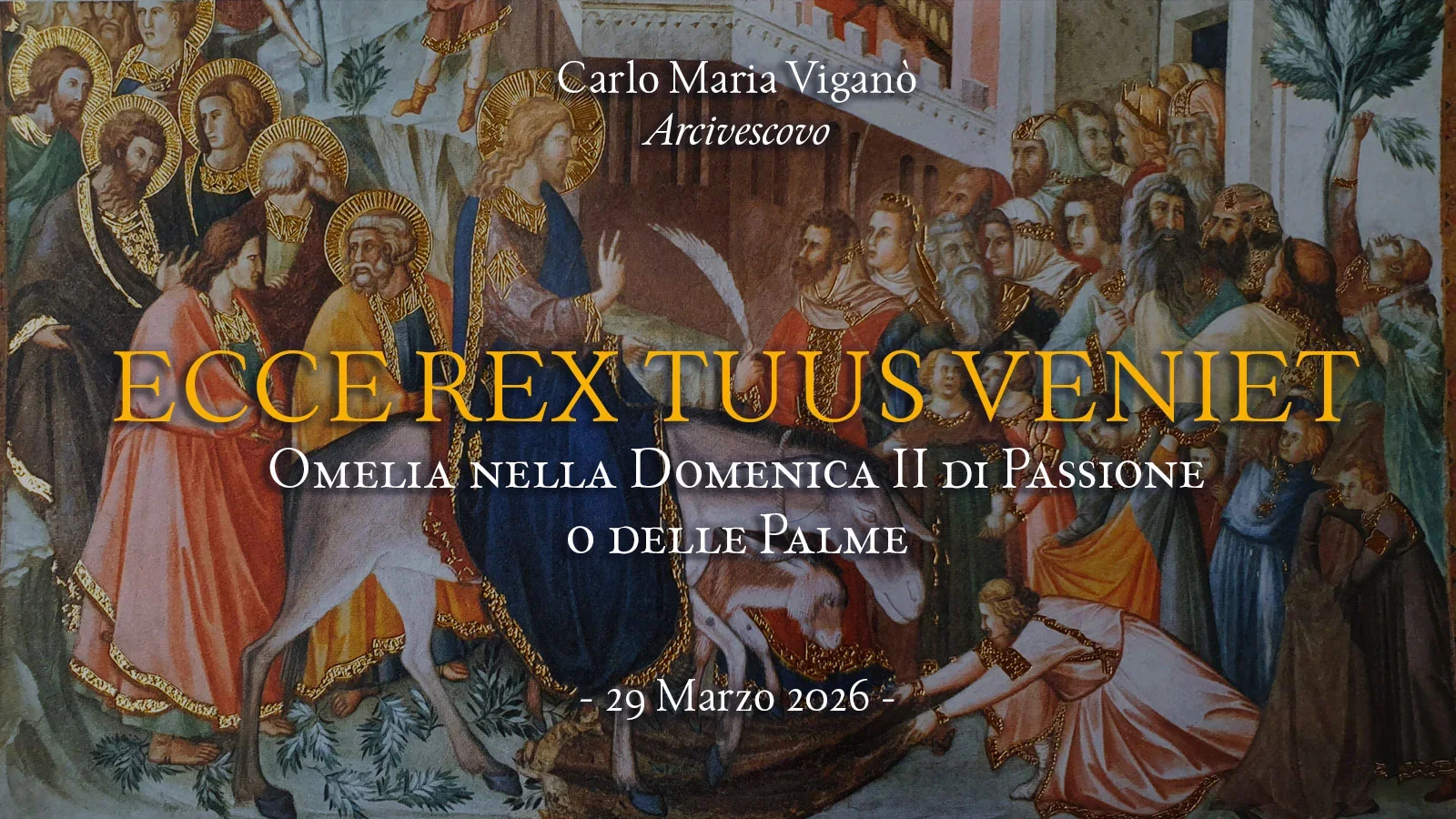
PALM Sunday commemorates the triumphant entry of the King-Messiah into Jerusalem, the liturgical mystery in which Holy Church contemplates the fulfillment of the royal prophecies of the Old Testament in the Person of Christ the Lord. It is not a mere historical commemoration, but an act of faith in the Kingship of Jesus, a humble yet victorious King, who enters the Holy City to consummate His Passion and open for us the gates of the eternal Kingdom. Yet, it remains, nonetheless, an historical event, attested to by all those who, on that day, witnessed the coronation ceremony of Our Lord Jesus Christ. According to the ritual described in the First Book of Kings (1 Kings 1:32–40), the dying David commands that his son Solomon be consecrated king; that he be mounted upon King David’s own mule (a symbol of peace and legitimate succession, not of war); led to the Gihon Spring (located at the foot of the Mount of Olives); and anointed with sacred oil by the priest Zadok and the prophet Nathan. He further prescribes that the trumpet be sounded and that the people acclaim Solomon as king. The procession of the new sovereign enters Jerusalem amidst shouts of jubilation, with the people playing flutes and the city “resounding with clamor” (1 Kgs 1:45). This rite was intended to prefigure the new king as the Lord’s Anointed (the Messiah)—the legitimate Davidic successor and bringer of peace.Our Lord enters Jerusalem riding on the foal of a donkey (Mt 21:2–7; Jn 12:14–15), fulfilling to the letter the prophecy of Zechariah (Zech 9:9). He is not an earthly king with warhorses, but the Rex pacificus, the true Solomon (whose name, in fact, means “peaceful”) qui venit in nomine Domini (Ps 117:26). The cloaks spread upon the road (Mt 21:8) recall the rite described in the Second Book of Kings (2 Kgs 9:13) for the anointing of Jehu; the palm and olive branches evoke victorious processions and the Feast of Tabernacles (Lev 23:40), yet here they also call to mind Christ’s Paschal victory over death.The triumphant entry of Christ the King from the priestly village of Bethphage and the Mount of Olives is not a random topographical detail, but an act of prophetic and typological fulfillment that recalls, in a wondrous manner, the sacred sites of Davidic and Solomonic kingship. It reveals Christ as the true Rex et Sacerdos — Davidic King and Eternal Priest according to the Order of Melchizedek — who enters Jerusalem to reign from the Cross, fulfilling and surpassing the coronation rites of the Old Testament . When the procession exits the church (an image of Bethphage) and re-enters singing Gloria, laus et honor, we are led to mystically relive this entry: like the people of old, we too acclaim the King who comes from the sacred mountain and the priestly house to reign in the New Jerusalem, the Holy Church.The triumphal entry of Christ the King from the priestly village of Bethphage and the Mount of Olives is not a random topographical detail, but an act of prophetic and typological fulfillment that admirably evokes the sacred sites of Davidic and Solomonic kingship. It reveals Christ as the true Rex et Sacerdos—Davidic King and Eternal Priest according to the Order of Melchizedek—who enters Jerusalem to reign from the Cross, fulfilling and transcending the coronation rites of the Old Testament. When the procession exits the church (an image of Bethphage) and re-enters singing Gloria, laus et honor, we are led to mystically relive this entry: like the people of old, we too acclaim the King who comes from the sacred mountain and the priestly house to reign in the New Jerusalem—the Holy Church.The cry “Hosanna to the Son of David!” (Mt 21:9) is the royal messianic acclamation . The Jewish people—with the significant exception of their temporal and spiritual leaders—acknowledge Christ’s hereditary title to the Davidic kingdom: He is the promised King, the legitimate heir to the throne of David, which at that moment was vacant , just as the priestly authority was also de facto vacant . The exclusion of civil and religious authorities from this solemn Jewish liturgy demonstrates how the Lord want to recapitulate within Himself both Monarchy and Priesthood, since He is by divine right, by lineage, and by conquest the one true King and High Priest of the House of Israel. Israël es tu Rex, davidis et inclyta proles.Our Lord Jesus Christ fulfills the Old Testament rites of coronation (anointing, acclamation, and solemn entry) in a preeminent, spiritual, and eternal manner. Yet this Messiah—the true and only Divine Messiah—is not the political leader of a supremacist party that the Pharisees were awaiting, but the Princeps pacifer who calls all nations to Himself, transcending every race and every tongue. Indeed, Saint Augustine observes: “The donkey’s colt, upon which no one had ever ridden, represents the people of the Gentiles—those whom no one, prior to Christ, had ever brought into subjection. The donkey, conversely, represents the multitude drawn from the people of Israel, who had long been beneath the yoke of the Law. Christ the humble King, seated upon both the donkey and the colt, signifies both multitudes: that of the Jews, already tamed, and that of the Gentiles, not yet ridden. And as a peaceful King, He arrives not upon a warhorse, but upon a donkey—a symbol of peace” . Saint Paul also confirms this: An Judæorum Deus tantum? nonne et gentium? Immo et gentium: quoniam quidem unus est Deus, qui justificat circumcisionem ex fide, et præputium per fidem. Perhaps God is the God only of the Jews? No, even of the Gentiles; certainly, even of the Gentiles, if there is only one God who will justify the circumcised through faith, as well as the uncircumcised through faith. (Rom 3:29-30).And again Saint Paul writes: Omnes enim filii Dei estis per fidem, quæ est in Christo Jesu. Quicumque enim in Christo baptizati estis, Christum induistis. Non est Iudæus, neque Græcus: non est servus, neque liber: non est masculus, neque femina. Omnes enim vos unum estis in Christo Iesu. Si autem vos Christi, ergo semen Abrahæ estis, secundum promissionem hæredes. For you are all children of God through faith in Christ Jesus; for as many of you as were baptized into Christ have put on Christ. There is no longer Jew or Greek, there is no longer slave or free, there is no longer male or female; for you are all one in Christ Jesus. And if you belong to Christ, then you are Abraham’s offspring, heirs according to the promise (Gal 3: 26-29) .It is to the New Israel that the zeal of true Charity of the Church of Christ calls the Jews, in accordance with the petitions that—at the initiative of the Lémann brothers—510 Fathers of the Vatican Council humbly submitted to Pius IX in 1870:that the poor people of the Jews, weary of a very long and futile waiting, may hasten to recognize the Messiah, our Savior, truly promised to Abraham and foretold by Moses: thereby perfecting and crowning the Mosaic religion, not altering it.The priests Joseph and Augustin Lémann, converts from Judaism and tireless apostles of the cause of Israel in Christ, saw in the “Hosanna” the acclamation that the Sanhedrin ought to have made its own, but which instead became a prelude to rejection: a perennial admonition so that Israel might recognize its King.Everything revolves around Christ the King and High Priest. Everything is decided on the basis of His recognition as Messiah, Savior, and Liberator. And until the remnant of Israel bows the knee to its Lord, the Final Judgment will not take place. The conversion of this remnant will precede the coming of Elijah, delay the judgment, and lead to the “resurrection of the world” (Rom 11:15) .This awareness, together with a correct interpretation of Sacred Scripture, leads us to view even the events of today in the light of the wondrous plan of Divine Providence. Nemo vos seducat (Eph 5:6): let us not allow ourselves to be deceived by those who delude themselves into thinking they can pass off the Antichrist as the true Messiah, or hasten the end of the world by building with stones that Temple which Our Lord, in a mystical sense, built once and for all within His own Mystical Body. Let us seek, rather—through the consistency of our lives and by the Grace of God—to become credible witnesses to the Divine Messiah, the Incarnate Word, the One whom, in a few short days, we shall contemplate seated upon the throne of the Cross: Regnavit a ligno Deus . And so may it be.+ Carlo Maria Viganò, Archbishop29 March MMXXVIDominica II Passionis seu in Palmis
CONDIVIDI QUESTA NOTIZIA