Cum Sanctis tuis in æternum
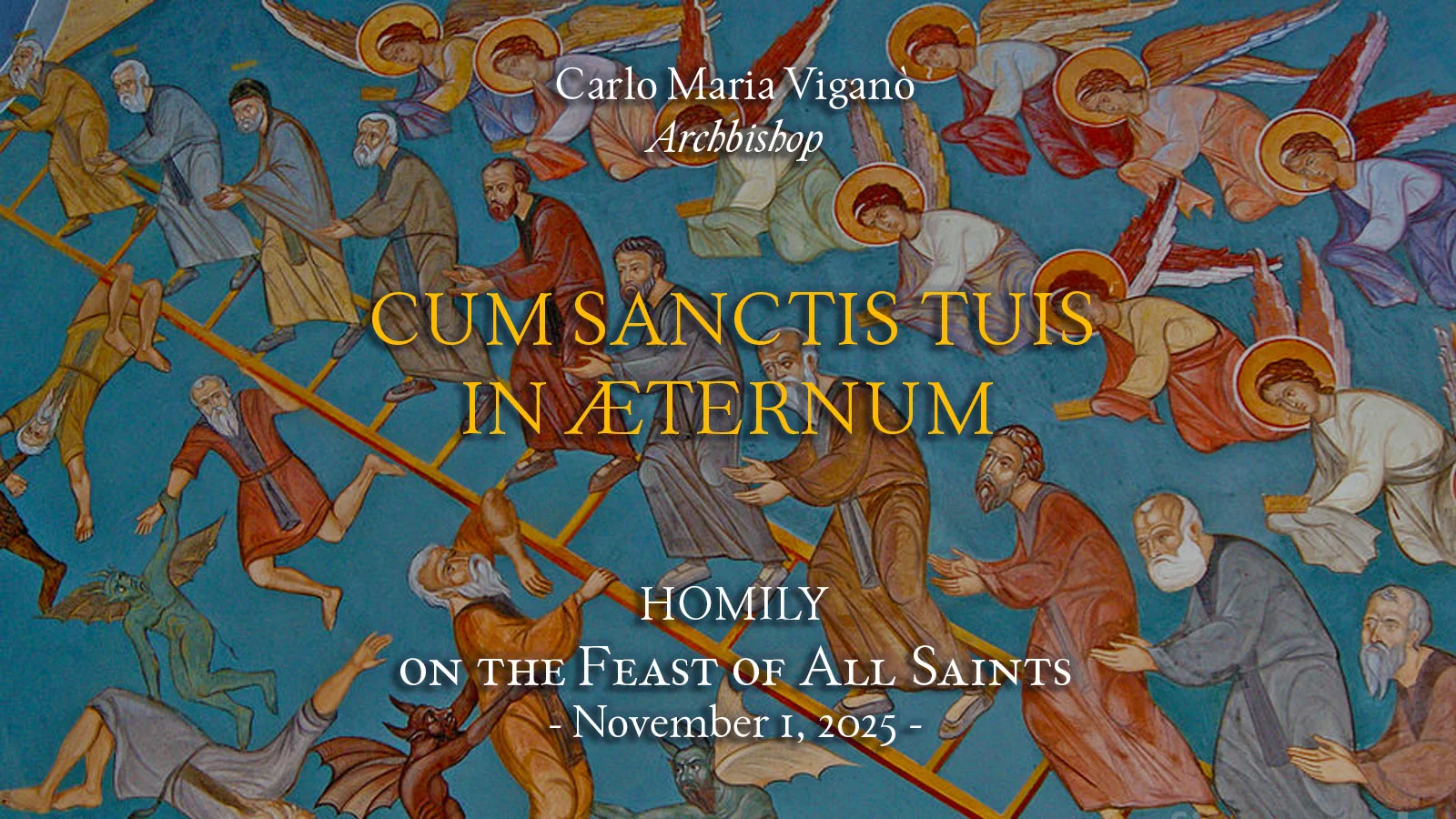
<p style="text-align: right;"><em>Vos, purpurati martyres,</em><em>Vos candidati præmio</em><em>Confessionis, exsules</em><em>Vocate nos in patriam</em>.</p><p style="text-align: right;"><span>Ye martyrs all, a purple band,</span><span>Confessors too, a white-robed train,</span><span>O call us to our native land,</span><span>From this our exile back again.</span></p><p style="text-align: right;"><span>Raban</span><span>us</span><span> Maur</span><span>us</span><span>Hymn</span><em> <span>Placare</span><span>, Christe</span></em></p><p><span>After the solemn celebration of the Kingship of Our Lord Jesus Christ</span> <span>on the last Sunday of October, </span><span>the First of </span><span>November is dedicated to those who fought with Christ in the </span><span>bonum certamen</span><span>, </span><span>meriting</span><span> to triumph with Him in </span><span>His</span><span> dazzling victory over the devil. </span><span>On t</span><span>he following day,</span><span> the Second of</span><span> November, another immense army of holy souls is remembered: those whom the fire of Purgatory purifies like gold in the crucible, mak</span><span>ing</span><span> them worthy of being admitted to the glory of contemplating the </span><span>D</span><span>ivine Majesty. </span><span>We see t</span><span>he King</span><span> surrounded by</span><span> His most valiant companions in arms, His soldiers</span><span>: </span><span>Prophets, Apostles, Martyrs, Confessors, Virgins and Widows; Popes, Bishops and Abbots; Kings and Queens</span><span>, as well as </span><span>the ranks of the simple faithful. And</span><span> we see also </span><span>the Queen of them all, the </span><span>Mistress</span><span> of the Militia, the Most Blessed Ever-Virgin Mary. And</span><span>, in addition,</span><span>the angelic hosts: Seraphim, Cherubim, Thrones; Dominions, Virtues, Powers; Principalities, Archangels, and Angels. </span><span>Myriads</span><span> of souls illuminated like a mystical firmament by the dazzling light of the </span><em><span>Sol </span><span>Justitiæ</span></em><span>, Our Lord Jesus Christ, King and </span><span>High Priest</span><span>.</span></p><p style="padding-left: 40px;"><em><span>Tibi</span> <span>omnes</span> <span>angeli</span><span>,</span><span>tibi</span> <span>cœli</span><span> et </span><span>universae</span> <span>potestates</span><span>:</span><span>tibi</span> <span>cherubim</span><span> et </span><span>seraphim</span><span>,</span><span>incessabili</span><span> voce </span><span>proclamant:</span></em></p><p style="padding-left: 40px;"><em><span>Sanctus, Sanctus, Sanctus,</span><span>Dominus Deus Sabaoth.</span><span>Pleni</span> <span>sunt</span> <span>cœli</span><span> et terra </span><span>ma</span><span>i</span><span>estatis</span> <span>gloriæ</span> <span>tuæ</span><span>.</span></em></p><p style="padding-left: 40px;"><em><span>Te </span><span>gloriosus</span> <span>Apostolorum</span><span> chorus,</span><span>te Prophetarum laudabilis numerus,</span><span>te</span> <span>Martyrum</span> <span>candidatus</span> <span>laudat</span> <span>exercitus</span><span>.</span></em></p><p><span>The o</span><span>nly</span><span> ones</span><span> missing from this vast gathering of Saints</span><span> are we</span><span> who in this </span><span>val</span><span>e</span><span> of tears</span><span> journey toward the heavenly homeland that we too often believe to be far away. A homeland from which we are </span><span>exsules</span><span>, exiles expelled by </span><span>D</span><span>ivine Justice as children of Adam and Eve, readmitted by Grace to the beatific presence of the Holy Trinity thanks to the Redemption of the New Adam and the Co-Redemption of the New Eve. We have many traveling companions with us; others have preceded us, others </span><span>whom </span><span>we will</span><span> still</span><span> meet along the way. Our parents, once </span><span>they</span><span> have left this fleeting life, will continue to pray for us in eternity, and we will find them waiting for us when our hour comes. Our children, our grandchildren, will</span><span> also one day mourn our loss</span><span>, and we will bless the time we taught them to recite a </span><em><span>De </span><span>profundis</span></em><span>, because their prayer will ease our purifying suffering and bring us closer to that </span><em><span>locus </span><span>refrigerii</span><span>, </span><span>lucis</span><span> et pacis</span></em><span> for which we so </span><span>ardently </span><span>long. We too will pray for them, </span><span>whether </span><span>from Purgatory </span><span>or</span><span> from Paradise, so that with the help of Grace they may be able to atone for their sins on this earth, through penance, fasting, and prayer; with Charity, </span><span>which <em>covers a multitude of sins</em></span><span> (1 P 4:8). Charity: the only Virtue that will never fail, because it is consubstantial with the One and Triune God. The Virtue whose fire burns with such love for God that it consumes </span><span>all </span><span>our infidelities.</span></p><p><span>Those of you who are still young, and think you still have a long time before the Particular Judgment, perhaps cannot understand why, in older people, a sort of </span><span>“</span><span>nostalgia</span><span>”</span><span> for the glory of Heaven becomes increasingly perceptible, making us almost desire death </span><span>in order to</span><span> reach the</span><span> Heavenly</span><span> Father and the </span><span>S</span><span>aints of </span><span>Paradise </span><span>sooner</span><span>. We older people feel this </span><em><span>desiderium patriae</span></em><span> that makes us yearn for it </span><em><span>more than the light of the sun </span></em><span></span><span>.</span> <span>It is a</span><span> desire that comes not from the memory of something we have left behind—</span><span>since we have </span><span>never</span><span> before</span><span> been admitted to Paradise—but </span><span>rather </span><span>from that </span><span>indelible mark</span><span> we bear imprinted on our nature and that reminds us that we are the work of the Creator</span><span>’</span><span>s wise hand, made in the image and likeness of the Holy Trinity, and that we too are </span><span>Trinitarian</span><span> in our faculties—</span><span>memory, intellect, and will</span><span>. The memory of the Father, the intellect of the Son, the will of the Paraclete.</span></p><p><span>We could say that the ancestral memory of Paradise lost has been transmitted, along with the consequences of original sin—death, illness, pain—just as the prodigal son </span><span>felt nostalgia </span><span>for</span><span> the house of</span><span> his Father, whose inheritance he ha</span><span>d</span><span> squandered. That poignant call reminds us where we come from, but above all it points us to</span><span>our </span><span>Patria</span><span> – </span><span>our</span> <span>H</span><span>omeland </span><span>for</span><span> which we are destined. The pilgrimage of the chosen people through the desert toward the Promised Land is a figure of the Church</span><span>’</span><span>s pilgrimage toward the </span><span>R</span><span>eturn </span><span>in Glory</span><span> of </span><span>her</span><span> Head, but also an image of the pilgrimage of each </span><span>one </span><span>of us</span> <span>toward the New Jerusalem.</span></p><p><span><img class="size-medium wp-image-10607 alignleft" src="https://exsurgedomine.it/wp-content/uploads/2025/11/image-14-300x164.png" alt="" width="300" height="164" />We </span><span>have been</span><span> created for glory. We were </span><span>intended</span><span>, and therefore loved, to share in the </span><span>G</span><span>lory of God the Creator, Redeemer, and Sanctifier. We are </span><span>members of the Royal Line</span><span> of</span><span> the</span><span> King, children and heirs of God, co-heirs with Christ. And our </span><span>inheritance</span><span> begins here, dear brothers and sisters. </span><span>It begins with the</span> <em><span>scala </span><span>crucis</span></em><span>, the</span><span>ladder of the cross depicted in medieval image</span><span>ry</span><span>, in which the Savior climbs the rungs of a ladder leading to the Cross. Our eternal inheritance begins with the voluntary acceptance of the cross that Providence has destined for us, and which is the only one we </span><span>are capable of carrying</span><span>, the only one we can serenely ascend,</span><span> the only one</span><span> upon which we can confidently open our arms. The</span> <span>scala </span><span>crucis</span><span> is also the </span><em><span>scala paradisi</span></em><span>, because in following the Redeemer, this</span> <span>via regia</span><span> leads directly to the presence of </span><span>the D</span><span>ivine Majesty. An evocative image by Saint John Climacus shows us souls ascending toward Heaven, with Angels accompanying them on the ascent </span><span>while</span><span> de</span><span>vils</span><span> try to drag them down.</span></p><p><span>The Saints—those</span><span> whom</span><span> we venerate on our altars, whose relics we incense, over whose remains we celebrate the Holy Sacrifice of the Mass, and who intercede for us in Heaven—are not the exception to a norm of mediocrity. It is not normal </span><span>not</span><span>to be saints. There were times when holiness was </span><span>synonymous</span><span> with being </span><span>a </span><span>Christian, because in the fury of persecution, men and women, </span><span>both </span><span>young and old, were called daily to face martyrdom. Many suffered it as catechumens, even before being admitted to Baptism. We bear their names precisely so that their example may </span><span>spur us on</span><span> to imitate them on the same path to holiness. We profess the same apostolic faith, we celebrate the same mysteries, and we continue to have the same enemies: the world, the flesh, the devil. A Catholic who does not want to be a saint, who does not desire Heaven, who does not yearn for God—</span><em><span>sicut </span><span>cervus </span><span>ad </span><span>fontes</span> <span>aquarum</span></em><span>—and who does not feel this "nostalgia" for the True and the Good has understood nothing of our holy Religion, much less of the miracle of infinite Charity that moved the Second Person of the Holy Trinity to become </span><span>I</span><span>ncarnate and suffer for us, with no other motivation than </span><span>D</span><span>ivine </span><span>L</span><span>ove for us and the </span><span>G</span><span>lory of the Trinity itself. For be</span><span>coming a saint</span><span> is indeed a duty </span><span>for</span><span> each</span><span> one</span><span> of us, in obedience to the precept: </span><em><span>Be holy as God is holy</span></em><span> (Lev 19:2; 1 P 1:16)</span><span>.</span> <span>B</span><span>ut if only we allow ourselves to be conquered by Our Lord, holiness is </span><span>then </span><span>no longer</span><span>simply</span><span> an obligation, but </span><span>rather </span><span>the necessary, spontaneous, and grateful response to the call of the King, under Whose banner </span><span>Holiness</span><span> is a military honor.</span></p><p><span>The Saints are those who have acclaimed and continue to acclaim: </span><em><span>Regnare </span><span>Christum </span><span>volumus</span><span>!</span></em><span> against the blasphemous cry of the</span> <em><span>scelesta</span> <span>turba</span></em><span>, the wicked crowd</span><span>. They are those who let their Lord reign first in their own souls, making them a worthy dwelling place of the Holy Trinity through the life of Grace and union with God. They are those who humbly allow themselves to be guided by the wise hand of the Lord, docile as a pen between His fingers, so that it may be clear that the</span><span> fruit of their</span><span> work is entirely </span><span>D</span><span>ivine. </span><em><span>Quoniam </span><span>tu</span></em><span><em> solus Sanctus</em>.</span></p><p><span>We </span><span>exiles</span><span>, however, </span><span>have been</span><span> granted a glimpse of Paradise on this earth. A glimpse of the glory of </span><span>the D</span><span>ivine Majesty that anticipates what awaits us and makes supernatural Graces available to</span><span> help us</span><span> undertake the journey to our </span><span>final destination</span><span>. We find this corner of Paradise in our churches, in our Tabernacles, around each of which all the Angels gather in adoration. We find it in the Holy Mass, when the priest </span><span>calls</span><span> down the King of Kings from Heaven, repeating in a bloodless form the Sacrifice of the Cross. And in this Paradise on earth, bounded by the columns and vaults of a church like the beams of a barn, we can receive the Body and Blood of Christ, </span><span>truly </span><span>present in </span><span>His </span><span>Body, Blood, Soul, and Divinity </span><span>exactly as He sits on the Throne of the Lamb in the </span><span>G</span><span>lory of Heaven.</span></p><p><em><span>Te per orbem terrarum</span><span>sancta confitetur Ecclesia,</span><span>Patrem</span> <span>immensæ</span> <span>maiestatis</span><span>;</span><span>venerandum</span> <span>tuum</span><span> verum et unicum </span><span>Filium</span><span>;</span><span>Sanctum quoque </span><span>Paraclitum</span> <span>Spiritum</span></em><span><em>.</em> </span></p><p><span>Perhaps it is precisely </span><span>as a result of</span><span> the sacredness of the Mass, the solemnity of its arcane gestures, the depth of its liturgical texts,</span><span> and</span><span> the impetuous torrent of Graces that the Holy Sacrifice pours upon us, that we experience that </span><span>“</span><span>longing</span><span>”</span><span> for Heaven, for the presence of our loved ones, for the light of the supreme Truth, </span><span>for </span><span>the warmth of perfect Charity, for the glory of God and His Saints. </span><em><span>Tu rex </span><span>gloriæ</span><span>, Christe. Cum </span><span>sanctis</span><span> tuis in </span><span>æternum</span><span>, quia </span><span>pius</span></em><span><em> es</em>.</span><span> And so</span><span> may it</span><span> be.</span></p><p><span>+ Carlo Maria</span><span> Viganò</span><span>, </span><em><span>Arc</span><span>hbishop</span></em></p><p style="text-align: right;"><span>1 Novemb</span><span>er</span><span> MMXXV</span><em><span>In festo </span><span>O</span><span>mnium Sanctorum</span></em></p>

CONDIVIDI QUESTA NOTIZIA